
Sunday, November 22, 2009
Desert Taxi - 1953
Adventure fascinates many;a few succumb to her call.There is a magic in the distance where the sky-line meets the earth http://


Friday, November 20, 2009
Thursday, November 19, 2009
Expedition Land Rovers through the Generations
What is it about the image of a dusty Land Rover parked on the rolling savanna of Africa? Is it the thought of exploration, freedom, and adventure?
In this blog, I link to a few Land Rover expeditions that have been used through the generations.

Land Rover Series I - 1948 to 1957
George Adamson drove from the UK back to Kenya as part of his honeymoon with Joy. His book, Bwana Game, tells the short story of his trip in his Series I Land Rover. The following photos are scans from his book. Apologies for the binding getting scanned in!

The Great 1953 Trek - a family of four drive from Bath, UK to Salisbury, Rhodesia (as it was known then).

Additional scanned photos from the various books I have sourced the information from. See the list at the end of the blog.

Wandering Star
I spotted a number of articles written about this Series I, however, I have never been able to track down the owner. Here is one of the articles, including a number of scanned photos.
     
Land Rover Series II - 1958 to 1970
Series IIa - the primary difference between this model and the previous was the introduction of the diesel engine and eventually the headlights moved to the fenders.
My first Land Rover was a 1968 Series II. It was fully kitted for overland travel - this included a rooftop tent, fridge, 2nd battery, two diesel fuel tanks, an overdrive and a noisy 2.286L diesel engine. Fully loaded, the vehicle could cruise at 50mph but lacked power to even attempt a normal incline. Engaging low range, via the red knob lever, was the only way the vehicle could tackle any obstacle.  Land Rover Series III - 1975 to 1985 A few additional modifications took place however the base chassis and body shell remained unchanged to the average person. The model varied from a three door, to five door 109" chassis or the alternative short wheel base 88". In recent years, overlanders have purposively chosen the Series III based on its rugged ability to endure all types of terrain, along with the basic mechanical knowledge required to keep the vehicle mobile. A few websites are listed on The Africa Overland Network. Under African Skies by Derek Lean  African Snail - Murray & Moira head South from the UK to South Africa via West Africa. Their vehicle had already completed a full Trans-Africa trip prior to them starting their expedition. 
A few more photos from the Archives:

Series III Lightweight
I can't seem to find any trips across Africa which have used the Series III Lightweight (which was effectively the UK military version of the Series III 88"). The one trip, Dollars and Chocolate, used a lightweight from the UK to Nepal.  Land Rover 110 - 2.5 (non Turbo) The first version of the iconic Land Rover Defender shape. In and Out of Africa - Derek Tearne (Flickr Photos)  Land Rover 200 Tdi With the development of fuel injection and the stability of turbos integrated into diesel engines, Land Rover released the 110 Defender fitted with the 200Tdi engine. The base engine was a 2.5l turbo diesel. I choose this vehicle for my most recent Trans-Africa trip based on the reliability, and maintainability of the engine. This vehicle, like its 110 predecessor was permanent four wheel drive. A centre diff was available to lock the diagonal wheels should the need be required. BigSky Adventures My first complete Trans-Africa trip was undertaken in this vehicle. My trip was the fourth Trans-Africa that this Defender had done. I, inturn, sold it to another overlander who completed an additional trip. I believe the vehicle is being sold and is ready for its next trip through Africa. 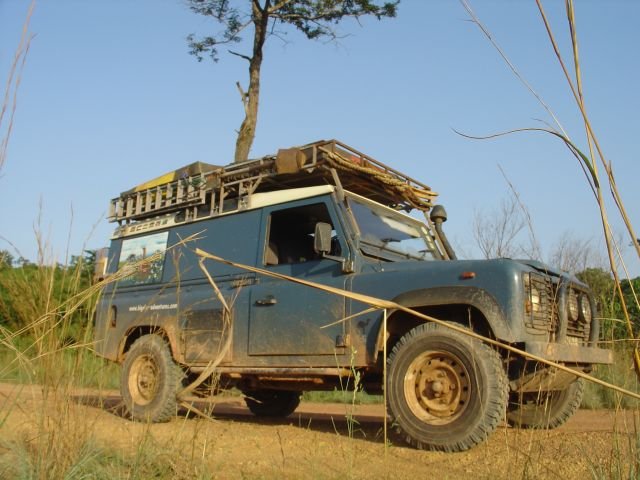 Land Rover 300 Tdi Increased power, modified turbo were the upgrades to take place ont this Defender. An immaculate example of this vehicle is the website below. Africa Wanderer  Land Rover TD5 Firstly, let me be honest here - I am battling to find anyone who has a Trans-Africa overland website based on the Defender TD5. I got close when Charlie Mouse Adventures wrote the following but later changed their minds and sold the TD5 for a fully prepared 300Tdi. With this in mind, we purchased a 1999 Land Rover Defender Td5 which we lovingly called “Bertie” the blue Land Rover (can you seem a theme developing here??) and immediately got to work researching what would need to be done to transform Bertie from a rather “pimped” Land Rover from Eastborne into an overland vehicle that would get us safely across Africa over the course of 11 months. Unfortunately, we were not wise in our initial choice – the newer Land Rover Td5 engines have an electrical control unit (ECU) the complexity of which, for most mechanics in Walthamstow, never mind sub-sahara Africa, would cause a sharp intake of breath. Still – having learnt this rather vital bit of info a bit too late, we thought we would persist with Bertie – although it would be a nightmare if anything did go wrong (requiring diagnostic computers not available in much of Africa), the Td5 engine is generally considered more reliable therefore less likely to go wrong … we would pray our way across Africa! So, my hunt for a fully Trans-Africa website using a TD5 continues... If you know of a website, please let me know. Land Rover Defender 2007 (Puma) Introducing the latest edition to the Defender family was the 2007 model, named the Puma by LR enthusiasts. The website Gapyear4x4, are currently travelling in a fully modified Puma. Click here for a video clip of the vehicle
I liked this page from the Gap Year 4x4 website - Boys side vs Girls Side
Land Rover 127 & 130
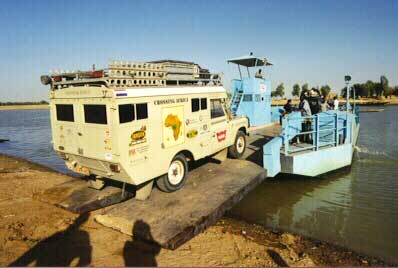
The vehicle was aptly named after the wheel base was stretched from 110" to 130". Les 4 O 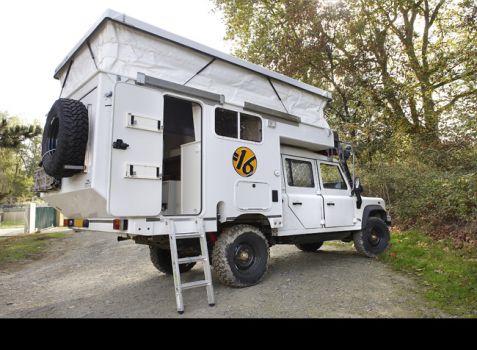 Land Rover Ambulance Although not a new design, the Ambulance body has been fitted to a number of Land Rovers over the years. As early as the Series II, various Ambulance rear bodies were built to provide support to the British Army. The benefit of these vehicles is the benefit to modify the interior as a camper. Here are a few sites that have used a Land Rover Ambulance: Crossing Africa
Land Rover Forward Control - the Land Rover Forward Control only lasted a few years in production. It offered easy camper conversions with plenty of space as described in this photo:  Not sure if the registration is the same in the Uk but in SA the Forward control is registered as a vehicle not a truck, we had to argue the point at most border crossings but always won in the end as it states this in the vehicle documents and carnet, the difference in taxes and "insurance" is huge. I fitted a 300tdi motor and did a few upgrades, true to Landrover nature the forward control is so universal, the size of the ambulance is perfect, not to big and not to small, you can fit everything you need inside the vehicle even a shower and toilet (important for the little one) and still have enough space to move around. Park and go the next morning without having to get out of the vehicle is a big big advantage. Land Rover 101 Forward Control - 1972 to 1978 Once again, Land Rover produced a vehicle for the British Army that had limited success. Fitted with a petrol V8 engine, the 101 was noisy and heavy on fuel. Overland trips in a Land Rover 101 are very rare - this could be due to a number of factors - limited numbers for sale, the perceived expensive of a V8 vs diesel and the age of the vehicle. In the last decade, only two Trans-Africa trips have used 101s and recorded their trip via a website. Enable Africa  Africa Total  In summary, the versatility that Land Rover brings to overlanding has enabled it be widely used throughout the generations. Its simplicity, functionality and ruggedness allow the driver to have confidence that the vehicle will cope and the expedition will reach its goal. Endless debates can be heard around campfires ranging from reliability, bolt-on bits and if the vehicle is the 'Best4x4xfar'. I will end with this one thought: Land Rover has enabled thousands of individuals to enjoy the concept of overlanding and will continue to do so. Comments always welcome. Books Referenced: Bwana Game - George Adamson Trans-Africa Motoring - Colin McElduff Overland - Peter Fraenkel |

Wednesday, November 18, 2009
Twitter - New World Trip Added
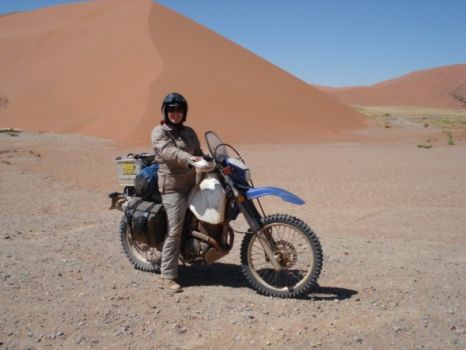
africaoverland - New world trip on motorbike - Back to Broke - Good blog, good videos & photos. http://
Wednesday, November 11, 2009
Tuesday, November 10, 2009
Early Land Rover Expeditions - the 1950s
When Land Rover introduced the Series I, advertised as the vehicle choice for all roles, expeditions started popping up. A few were well funded and even sponsored by Land Rover.
Here are a few books and photos written about the expeditions:
Starting with the most famous of all the 1950's expeditions:
First Overland - Tim Slessor

A few additional photos from Google Images:

The Impossible Takes a Little Longer - Eric Edis

A few photos from the above link:


Earth, My Friend - Peter Townsend
A few photos from the hardcover book:


Gipsy Doctor - Wendy Carnegie

The First Overland - Four Wheels & Frontiers - Roy Follows
Not to be outdone by the Land Rovers, Roy Follows equips an old WWII Jeep found on a scrapheap in Singapore and drives it back to the UK.
In 2002, Roy Follows (the author), sent me the first chapter of his book Four Wheels & Frontiers. On first glance, the book immediately inspires you to get reading as the photos in the book entice you into one of the first overland journeys from Singapore to England!
The book includes the authors journal and all planning letters, mileage and even GPS reference points for border crossings! Well worth buying a copy!


Here are a few books and photos written about the expeditions:
Starting with the most famous of all the 1950's expeditions:
First Overland - Tim Slessor

Why not? After all, no-one had ever done it before. It would be one of the longest of all overland journeys, from the English Channel to Singapore. Several expeditions had already tried. Some had got as far as the deserts of Persia; a few had even reached the plains of India. But no-one had managed to go on from there: over the jungle-clad mountains of Assam and across northern Burma to Thailand and MalayaSource: http://www.firstoverland.com/
A few additional photos from Google Images:

The Land Rovers are driving next to the Nairn Transport Co. truck.
The Impossible Takes a Little Longer - Eric Edis

Eric Edis, described as a real life Indiana Jones, set out from London on October 28 in 1957 with a team of 10 men and five women to attempt the overland journey across the world and back. Only one woman and one vehicle made it with him as far as Australia, as the harshness of the expedition took its toll. On the road for 18 months and five days, Edis finally arrived back on home ground 0n March 21, 1959, having endured and achieved more than the most intrepid Rider Haggard hero.Source: http://www.pressdispensary.co.uk/feed/991900.php
A few photos from the above link:


Earth, My Friend - Peter Townsend
Over the thousands of miles I had driven alone across the plains and mountains, the dark forests and deserts of the world, in the great cities and mud-hut villages, I had seen not only humanity but all kinds of living things unfolded in their infinite diversity...
A few photos from the hardcover book:


Gipsy Doctor - Wendy Carnegie
"This story tells of my adventures whilst driving a Land Rover and a a twenty-two-foot caravan from England to India. I believe it was the first journey of its kind, and it covered two-an-a-half years of travel" - Wendy CarnegieAn extract from the book:
The desert, as well as producing great, great heat, produces a series of shocks as well, for until he or she actually saw it, who could envisage a desert full of stones like small dark eggs instead of sand? That was what I found in the Black Desert, where I also encountered mirages that had to be seen to be believed.

The First Overland - Four Wheels & Frontiers - Roy Follows
Not to be outdone by the Land Rovers, Roy Follows equips an old WWII Jeep found on a scrapheap in Singapore and drives it back to the UK.
In 2002, Roy Follows (the author), sent me the first chapter of his book Four Wheels & Frontiers. On first glance, the book immediately inspires you to get reading as the photos in the book entice you into one of the first overland journeys from Singapore to England!
The book includes the authors journal and all planning letters, mileage and even GPS reference points for border crossings! Well worth buying a copy!


Additional links:
Friday, November 6, 2009
Vaccinations - What are required for Africa?
Vaccinations - important or not?

Prior to the start of our BigSky Adventures Overland trip (in fact, a good few months before), we started our vaccinations. Although expensive, it makes you aware that soon you will be leaving home and starting a trip of a lifetime.
In this blog, I give a quick overview of the important vaccinations that are required for your health and for certain border crossings.

A quick story - on the 4th June 2005, my wife and I, along with our travelling companions crossed from Cabinda, Angola into the DR Congo. See the Russian Map with our GPS tracklog in Red ending at the nights bushcamp.
It was the usual mayhem or a border crossing but something unique took place that day. Generally a border crossing involves Immigration, Customs and Police. This day, we were introduced to the Health Officer and his team.
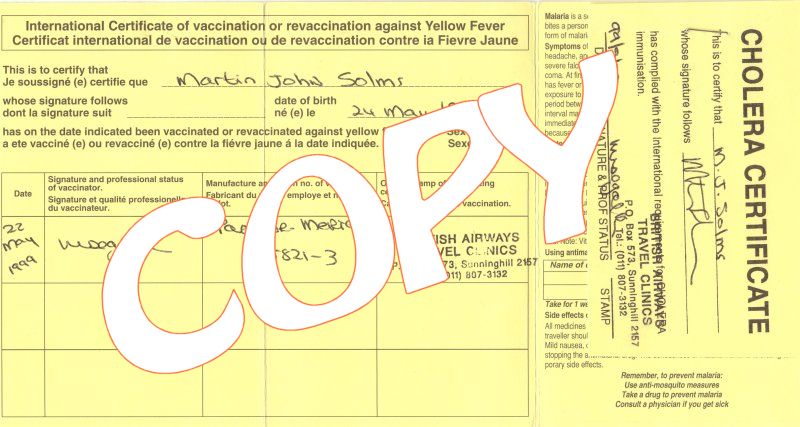
This was the first time we had been asked for our vaccination certificates. I produced my yellow certificate with the big words Cholera and Yellowfever. This certificate was acceptable. My wife's certificate, having been issued only a few months before, was a blue and white book and did not have the typed words Cholera (as this is not longer a mandatory vaccination). The Health Officer was not convinced until we eventually pointed out that my wife had indeed had the vaccination and that it was written in the book.
This was only part one of the visit with the Health Office - on the day I wrote the following on the website:
In summary, it is worth making sure that you have your vaccinations and that you have the paperwork ready.
Vaccinations required:
This list is not extensive and should only be used as a guideline. Consult a travel clinic or your local travel clinic prior to travelling.
Yellow Fever - This is a mosquito-borne viral disease. Illness ranges in severity from a flu-like syndrome to severe Hepatitis and Hemorrhagic (multiple systems are affected like vascular system) fever. Typically found in sub-Saharan Africa and tropical South America. An international Yellow Fever certificate is required.
Hepatitis A - Usually transmitted via contaminated food and water. It attacks the liver and my lead to jaundice and prolonged illness.
Hepatitis B - This virus is transmitted sexually and by contaminated needles. The vaccine is a three dose course over six months. Plan ahead so that you don't run out of time to get immunised.
Typhoid Fever - Typhoid Fever is more common in areas of the world where hand washing is less frequent and water is likely to be contaminated with sewage.
Tetanus - This is a serious bacterial disease contracted following contamination of deep puncture wounds. Typically if one is involved in a car accident. The vaccine lasts for 10years.
Cholera- This virus is transmitted by contaminated food and water. The infection is rare in travellers unless work is being done in refugee camps or hospitals. Most countries only issue a Cholera certificate, however, there is a new Cholera vaccination (oral type) which lasts for 2 years.

Meningitis - Typically only transmitted via infected persons. There are different strains throughout Africa. There is a multi-strain vaccination available.
Malaria - The most popular and dangerous disease that typically spreads by mosquitoes that bite from dusk to dawn. Three types of drugs are available: Doxycycline (1 tablet per day), Malarone (1 tablet per day) and Mefloquine (Lariam - 1 tablet per week). All have different side effects and total trip duration time lines.
Rabies - Rabies is transferred from a bite of a rabied animal. The infection affects the nervous system. Domestic animals only account for 10% of the rabied population. The vaccination is a multi-injection prescribed over a few months. Our worry is getting bitten by a monkey or a dog.
Additional Links:
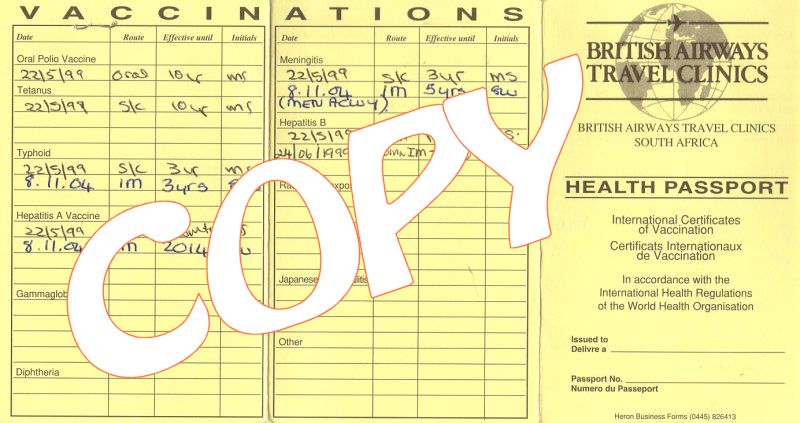
In this blog, I give a quick overview of the important vaccinations that are required for your health and for certain border crossings.
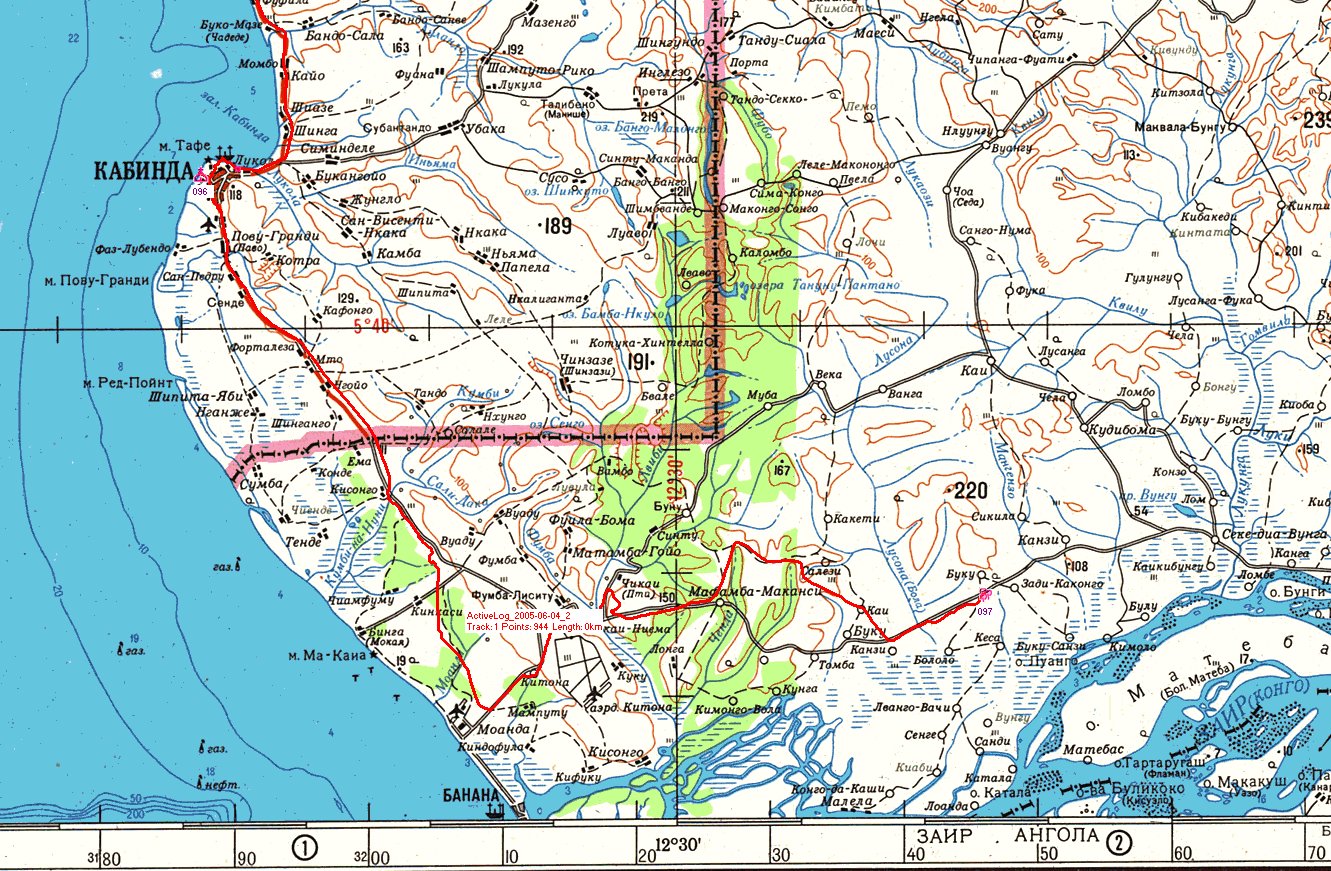
It was the usual mayhem or a border crossing but something unique took place that day. Generally a border crossing involves Immigration, Customs and Police. This day, we were introduced to the Health Officer and his team.
This was the first time we had been asked for our vaccination certificates. I produced my yellow certificate with the big words Cholera and Yellowfever. This certificate was acceptable. My wife's certificate, having been issued only a few months before, was a blue and white book and did not have the typed words Cholera (as this is not longer a mandatory vaccination). The Health Officer was not convinced until we eventually pointed out that my wife had indeed had the vaccination and that it was written in the book.
This was only part one of the visit with the Health Office - on the day I wrote the following on the website:
Formalities took a couple of hours to complete - the really unusual bit of the process was the interview with the medical officer. Producing a thermometer, the officer indicated that he wanted to take our temperatures. Concerned about placing the thermometer in our mouths (!) - the officer and all the 'add-ons' burst out laughing. Not mouths - but armpits! Whilst waiting for thermometer to register our healthy temperatures, he jotted in his journal and eventually we were allowed to proceed. We think this has to do with the Ebola / Marburg virus.
In summary, it is worth making sure that you have your vaccinations and that you have the paperwork ready.
Vaccinations required:
This list is not extensive and should only be used as a guideline. Consult a travel clinic or your local travel clinic prior to travelling.
Yellow Fever - This is a mosquito-borne viral disease. Illness ranges in severity from a flu-like syndrome to severe Hepatitis and Hemorrhagic (multiple systems are affected like vascular system) fever. Typically found in sub-Saharan Africa and tropical South America. An international Yellow Fever certificate is required.
Hepatitis A - Usually transmitted via contaminated food and water. It attacks the liver and my lead to jaundice and prolonged illness.
Hepatitis B - This virus is transmitted sexually and by contaminated needles. The vaccine is a three dose course over six months. Plan ahead so that you don't run out of time to get immunised.
Typhoid Fever - Typhoid Fever is more common in areas of the world where hand washing is less frequent and water is likely to be contaminated with sewage.
Tetanus - This is a serious bacterial disease contracted following contamination of deep puncture wounds. Typically if one is involved in a car accident. The vaccine lasts for 10years.
Cholera- This virus is transmitted by contaminated food and water. The infection is rare in travellers unless work is being done in refugee camps or hospitals. Most countries only issue a Cholera certificate, however, there is a new Cholera vaccination (oral type) which lasts for 2 years.
Meningitis - Typically only transmitted via infected persons. There are different strains throughout Africa. There is a multi-strain vaccination available.
Malaria - The most popular and dangerous disease that typically spreads by mosquitoes that bite from dusk to dawn. Three types of drugs are available: Doxycycline (1 tablet per day), Malarone (1 tablet per day) and Mefloquine (Lariam - 1 tablet per week). All have different side effects and total trip duration time lines.
Rabies - Rabies is transferred from a bite of a rabied animal. The infection affects the nervous system. Domestic animals only account for 10% of the rabied population. The vaccination is a multi-injection prescribed over a few months. Our worry is getting bitten by a monkey or a dog.
Additional Links:
-
-
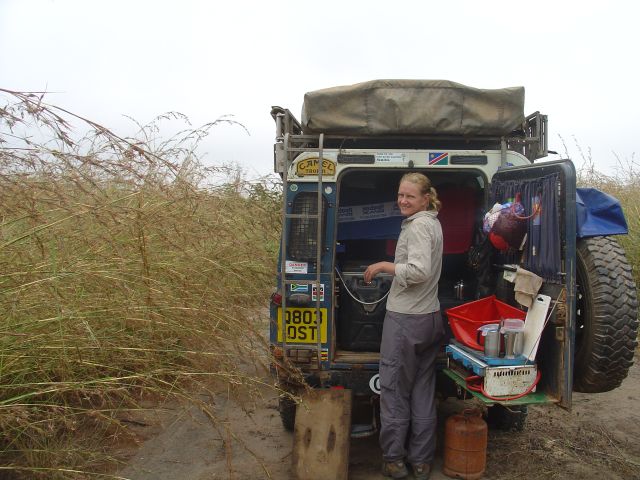
Our first bushcamp after crossing the Cabinda / DRC border:
Tuesday, November 3, 2009
History of The Africa Overland Network

I often get asked why I started The Africa Overland Network.
Here’s a quick overview of why I started the site and the reason behind it.
I started the project late 2000 as a result of my personal website which tracked overland websites. I hungered for overland information – where did people go, how did they modify their vehicle, how much did it cost and where are the best bushcamps situated. My personal website was a generic mix of Land Rovers, Travel, Overland and the odd family family. Overall it was not that applicable as a dedicated site hence the move to the dedicated site.
The first website which inspired me...
 In early 1996, I was searching the web, using an early version of Netscape browser and a 18k modem line, for Land Rovers, overland and expeditions based websites. I stumbled upon a new website called ‘In Search of Lovedu’. Heading South from London to South Africa (via West & Central Africa), this website was being updated as the journey progressed - a new concept was being established: live overland reports as the trip happened. According to the website author (Ann Jones), this was a lengthy process of recording the website on a floppy disk and posting it to the USA. It would then be copied onto the site - a few updates got lost, misdated but the concept of live internet updates was on the edge of the internet.
I was intrigued by the sites ability to keep relatively updated and so began the process of documenting my first overland trip in a 1968 Series II Land Rover. See ‘To Africa and beyond’ for the website.
Over the next few years, I started collecting and receiving links from other overlanders. In September 2000 I launched The Africa Overland Network – a site dedicated to independent overland trips. Primarily privately funded these websites offers diary updates, photos, GPS coordinates and embassy visa information and as internet access has increased video clips. Information on the websites range from single line entries to paragraphs of useful, and sometimes useless information. The uniqueness of each site is still the personal aspect and the fact that for most people, this is the first endeavor into the overlanding world.
Although the site is primarily Africa based, more independent trip were springing up with covered The Americas, Australasia and world trips. The site now hosts a vast number of those trips – see below for a few stats.
One downside of independent trips is the fact that websites are generally created for the duration of the trip. I estimate that about 300 trips are now lost due to websites closing down. As a result, I now offer a hosting service for websites that are about to expire.
Keeping a website like this updated has taken a lot of time. I went through phases where I would not update the site for months due to the manual method I used of creating the BIO page. I came to the conclusion that the only way the site could grow would be through a professional web design and the ability for easy uploads and management. The new site offers all this...
The website evolves… here are a few screen shots of the website as it has evolved over the years:


A new concept I started in 2001 was the use of a guestbook to allow people to advertise their trip - after about 80 odd trips, the concept evolved and vanished.

The current concept begins to evolve - a new colour scheme, rotating banner and more trips... still very manual and cumbersome to update so the design had to be modified.

I have always been interested in overland books - this layout, attempted to list books as I read them.

In 2008 I opted to spend a lot of money to have the website modified with an admin system as the process of creating a new BIO page was taking to long and the formatting was always different. The result was the new look and feel, which offered easier access, plus the ability to search for trips.
Evolving ever further, another need sprung up and that was the ability to keep updated with new content. Thanks to the concept of RSS feeds, Overland-Live now uses Google Reader to collect and present all the latest video, diary, photo and forum updates. And not to mention, the new concept of Twitter.

A few statistics:
Websites listed – 670 (a few lost links amongst those)
Websites viewed by day – about 500
Subscribe to:
Posts (Atom)