Showing posts with label vehicle. Show all posts

Friday, January 10, 2014

Land Rover or Toyota: What happened in 2013?

Was Land Rover or Toyota the preferred vehicle choice in 2013 for independent trans-Africa overland travel?  In this blog post I outlined the preferred vehicle choice for 2013, average travel time in 2013 and a summary of different vehicles used over the last four years.

The Africa Overland Network was formally launched in September 2000 and currently has over 800 independent overland websites listed - this website provides an excellent base for actively monitoring overland trips departing per year.

Over the last decade of independent overland travel, the preferred vehicle has been Land Rover but in 2011, Toyota became the preferred vehicle of choice.  In 2012, Land Rover bounced back to claim the number 1 spot. What happened in 2013?

Here are the links to the previous overland website statistics: 2010 | 2011 | 2012

The 2013 Stats...

Land Rover and Toyota once again proved to be the most popular choice for overland travel in Africa (departing in 2013). A total of 53 websites are listed on the website (departure date in 2013), surprisingly the same number for 2012.  I acknowledge that I have probably missed a few trips (and websites) as its hard to keep updated and often travelers don't know about The Africa Overland Network.

Sunday, November 29, 2009

Land Rover Discovery - A reliable Overland Vehicle?

Is the Land Rover Discovery a capable trans-continental overland vehicle?
Throughout decades of overland travel the Land Rover Series and Defender have been successfully crossing continents. In this post, I provide examples of the Land Rover Discovery and its role in Trans-Africa overland trips. I focused specifically on independent overland websites which opted to use a Land Rover Discovery as the preferred vehicle.

  Wikipedia describes the vehicle as:

The Land Rover Discovery is a mid-size SUV, with off-road capabilities, from the British car maker Land Rover; a subsidiary of Tata Motors. There have been three generations of the vehicle, which was first introduced in 1989.


Key Points
In my opinion, gone are the days where the dominant 4x4 vehicle was the Land Rover Series or Defender model, as a result there are a number of key points on why the Discovery is becoming more popular with the independent overlander.   The Discovery offers the following:
  • Superior comfort compared to the Land Rover Defender.  Majority of Discovery's include sunroofs and air conditioning.
  • Similar size to the Defender (physically less rear load space but extra width is beneficial)
  • A raft of overland equipment - roofracks, fuel tanks, bullbars and every other possible modification available
  • In the UK, the Discovery is very affordable compared to the Defender. 
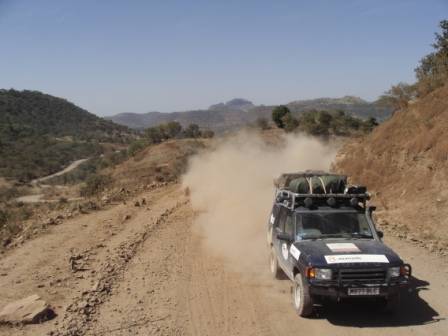
In each of the examples below, the Overlanders have opted for various modifications -  from the standard roofrack and tent, to a fully plumbed in fresh water tanks and long range fuel tanks.  

First introduced in 1989, the Land Rover Discovery launched in a market that was ready for a medium size 4x4. Similar to the Defender, this vehicle offers excellent offroad capability plus the interior offered comfort and airconditioning.


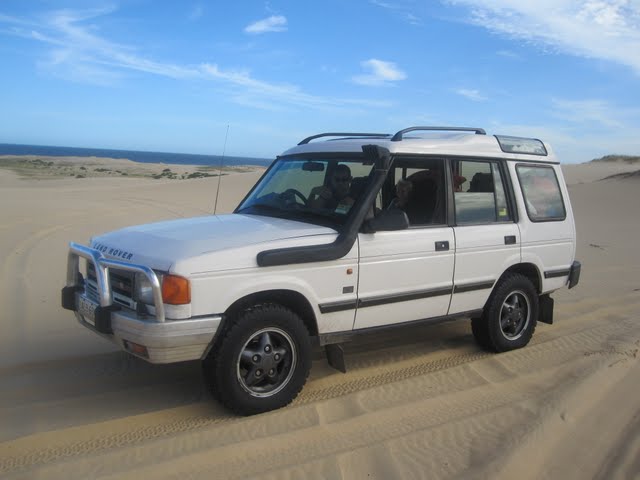
My first Discovery, as pictured below, was a 200tdi (2.5 Turbo Diesel), five door model.  The vehicle had a five speed gearbox, with a central locking diff in either high or low range.  


Here are a few overland prepared examples:

In April 1999, Scott and Renee headed South from Spain en route to South Africa.  The Discovery chosen for the trip was the 200tdi, 3-door edition.  


The additional benefit over the LR Defender was the wide rear door which enabled easy access to rear of the vehicle as seen in this photo.


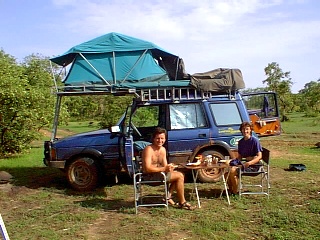
Prepared to the n'th degree, Andrew and Jacqui spent plenty of time and effort in kitting the perfect vehicle.  The Discovery had access to the rooftop tent (via the front sunroof).  The rear seats were removed and cupboards fitted to contain all the travel equipment.  A long range fuel tank, and two water tanks were fitted.


Additional photos from an afternoon spent at the UK Land Rover Billing show:


Land Rover Discovery 300tdi
Launched in 1994, this Discovery had the new 300tdi engine (2.5L TD), facelift headlights and interior.  Additional changes included a new gearbox and a few extra chassis modifications.

A few examples of trips...

Taniya and Clive are currently heading South from the UK and have a good website with excellent photos and videos.  


A short YouTube video clip shows the vehicle:


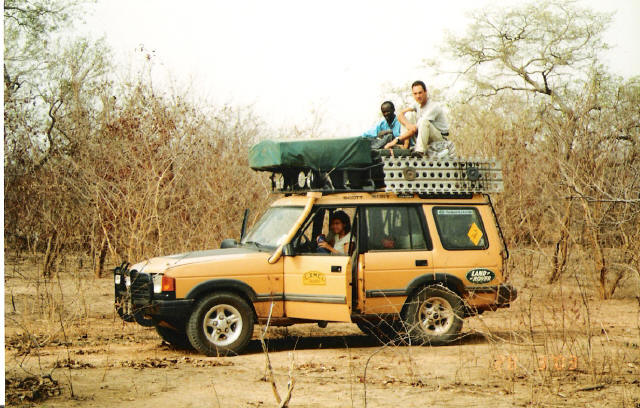
Peter Strong bought a fully kitted Camel Trophy Discovery and headed South and eventually North again.
Peter journals:
The Camel. 300TDi Discovery (P244 KAC) that was factory built for the Mongolia Camel Trophy Competition in 1997. I found the Camel in the care of Simon Pitchford in Gibraltar. Simon was gutted to lose one of his favourite toys - I was delighted to find a vehicle that was capable of taking the journey on.


Colin and team headed South from the UK in a Discovery.


Wayne and Tracy write the following about their Discovery 300tdi:
We decided on a Land Rover for our trip and bought a 1998 Land Rover Discovery 300TDi in early 2008.  The Landy was partly modified from a previous trip but we felt that it was not adequately prepared for our needs and still needed a lot of work and TLC to get it ready for our trip.


Launched in 1998, the Discovery II was the first vehicle to use the new 5-cylinder diesel engine (TD5) plus the new 'fly-by-wire' electronics which controlled fuel injection, traction control, and Active Cornering Enhancement (ACE) which prevented body roll. 

Paul and Jacinda headed North in their TD5 - their website offers an excellent vehicle prep page, including updates on equipment used.  

Quote from the website:
The most important accessory in my opinion for a diesel 4wd is a snorkel. Get water in a diesel and given the high compression ratio you can say goodbye to your engine. Apart from keeping water out they do a reasonable job of keeping the dust out and suck cooler air to boot. Combined with a K&N air filter, Truckasaurus breathes at its best.
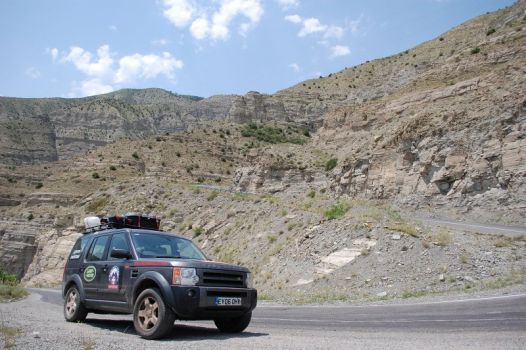
This Discovery launched with a totally new design, including the innovative Terrain Response system and 6-speed gearbox.


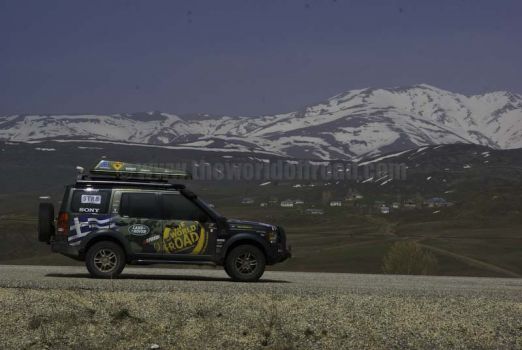
The World Off Road
Akis and Vula have a superbly modified Discovery 3.  They are yet to reach Africa (Nov 09) however as they are currently travelling, I will include them.  As stated above, the criteria to be included is an independent website detailing their Trans-Africa overland trip.


Big Adventure
Jen & Noam are heading around the world in their overland prepared Discovery 3 (2.7 diesel)


Land Rover Discovery 4
Launched in September 2009, this Discovery introduced a new 3.0l twin turbo diesel engine, smoother body lines and new interior trim levels (to match the Range Rover).  This Discovery is still relatively new and attracts a price point that most independent overlanders tend to avoid.


In summary, the first Discovery offers a fantastic overland vehicle - engine reliability, ability to easily modify and the 'Good Look' feel about it.  The benefit this vehicle has is the 2nd hand price point, the expedition kit availability and the lack of electronics.
Moving to the TD5 version introduces the electronics - however, with the right computer, diagnostics will be a breeze.  Additional spares will also need to be carried in advance of any breakdowns as remote areas will probably not have the latest diagnostic equipment.

As time moves on and we look back in ten years, I expect to see more electronics in vehicles and easier diagnostics which should make the newer Disco 3 & 4 available as an overlander.

Additional Reading:

10 Reasons why the Discovery makes a good overlander

Sunday, October 18, 2009

Overland Vehicle Insurance

What insurance is needed for Africa?  In this blog, I provide an overview of third party insurance for a Tran-Africa trip.
A mandatory requirement for every country in Africa is third party insurance.  In theory, this insurance will cover you for any accidents that may occur.  In reality, it's essential cover that will provide evidence at each police check point but will probably not cover you legally if you opt to go to court.  In most accidents, financial settlement will be negotiated and payment made in cash to the third party.

Majority of the African countries are covered by two consortium's, namely, Ecowas Brown Card and the Comesa Yellow Card.

Ecowas Brown Card
Ecowas refers to The Economic Community Of West African States and covers fifteen countries. Wikipedia provide a list of all current and past countries.
The insurance is provided in the first country of entry and is valid from the entry date.  Payment is usually in CFA or the equivalent Euro.
The Brown Card replaces the original Grey Card.  In some remote border posts, the police might refer to the insurance as Grey Card.


The following examples are from the BigSky Adventures 2005 overland trip.

Front Cover

First Page

List of Countries as per the insurance booklet.

Comesa Yellow Card
Comesa refers to the Common Market for Eastern and Southern Africa. Wikipedia provide a list of the current and past member states.  Payment is usually in the local currency at the first border post or in US Dollars.


The following is an example from BigSky Adventures.


Other Countries
I don't have records of all the other countries we passed through but have the following:


Morocco
A few EU countries provide third party insurance for Morocco.  Alternatively, insurance may be purchased at the first border crossing.  The process is relatively confusing but once at the correct office, the forms are simple if you have a copy of your vehicle documentation.


Mauritania


Zambia
I have a copy of the Zambian vehicle insurance but also remember buying the Comesa insurance.  Additional clarification is required so double check prior at the border.


Vehicle Resume
One tip I was given was to create a English / French Vehicle Resume. We printed off about 100 copies and used them at each border, and police checkpoint.  It saves plenty of time and often the Police are happy to take the piece of paper rather than write the details down.
An example is provided below:

Monday, September 21, 2009

Overland-Conversions : The Bongo

There is no doubt about it – a vehicle parked in the bush needs to look like it’s been there before!

That said, nothing looks as good a fully kitted Defender blending into the bush with a rooftent, wheel on the bonnet and dust on the dashboard.  Land Rover might have opened up the continent to exploration but the reliability and distribution network of Toyota has claimed the market.

My question today:  Is a fully kitted 4x4 required for an overland journey?  Fitting long range fuel tanks, huge spotlights, and chunky mud terrain tyres needed?

There is no quick YES or NO to the above question.  I will add that this topic has been debated to the n’th degree and often leads to fireside chats about the bests overland vehicle. 

I want to add a few comments today about the alternative option to the standard Land Rover or Land Cruiser.

The Requirements:
A few requirements are essential in overland travel – a comfortable place to sleep;  good cooking equipment (Fridge & Gas); fresh water tank; packing space
A few non-essential items – winch; spotlights; long range fuel tank; 2nd spare wheel; Hi-Lift Jack;

Here’s my thought – Why not take a factory fitted campervan, built to Japanese reliability, and transform it into an overlander.


Introducing the Mazda Bongo Camper Van.

First introduced back in 1966, the Mazda evolved until the recent launch of the Bongo in 1995 and a facelift in 1999.
As part of the SG Platform, the Mazda Bongo and Ford Freda share the same design. 
The Mazda Bongo is fitted with a 2.5l Diesel engine and has a 4wd drive train, and automatic gearbox.  The engine is the same engine as fitted to the previous range of Mazda doublecab vehicles.
The 4wd does not offer a low range combination which might be a hindrance depending on the route.


The benefits of this vehicle are numerous – factory fitted pop-up roof bed, fridge,  inbuilt water tank and plumbing;  gas hob; blinds on all windows; storage space; air conditioning.

The upgrades required:
A host of modifications are available – a few that I think are beneficial.
  • All Terrean Tyres on larger rims
  • Rear Diff lock
  • Spare well on exterior of vehicle


Watch the following sales YouTube clips for a visual overview of the vehicle:


Mazda Bongo & Ford Freda Standard Equipment

-Twin Air Conditioning climate, front and rear
-Automatic Gearbox With Overdrive.
-Power Steering
-Electric Windows
-Electric Folding Mirrors
-Electric Elevating Roof with 2 berths
-Central Locking all round, with power lockdown
-Fully trimmed interior
-Spot Lamps
-Side Window Blinds.
-Rear Heating


Mazda Bongo & Ford Freda Optional Extras
-ABS (1996 on)
-Drivers Airbag
-Alloys Wheels
-Towing Kits
-Cd Changer
-Front NudgeBar


Mazda Bongo & Ford Freda Measurements and Weights
Length 4.60 Mtrs
Height 2.10 Mtrs
Width 1.70 Mtrs
Weight 2325 Kg,s
Towing 2800 Kg,s

Interior Layout of both the Mazda Bongo and the Ford Freda
2 Front seats/Driver and Passenger
Central sliding Bench (reversible)
3 seat 60/40 with belts.
Rear split sliding/folding bench
3 seats.

Upper birth sleep 2 adults 7'0 x 4' 2
Lower birth sleep 2 children 6'2 x 4' 2


Mazda Bongo & Ford Freda Technical & Engine Specification
SGL 5 Model is 4WD (Permanent)
Engine is in line 4 Cylinder
2500 DIESEL INTERCOOLER TURBO
Max.POWER:130PS(135Bhp)/4000rpm
Max.TORQUE:294Nm/2000rpm
Mpg Urban 28, Extra Urban 34.
Source: http://www.algysautos.com/BONGO_TECHNICAL.html

Any comments on whether this vehicle has the capability to complete a full Trans-Africa trip…